
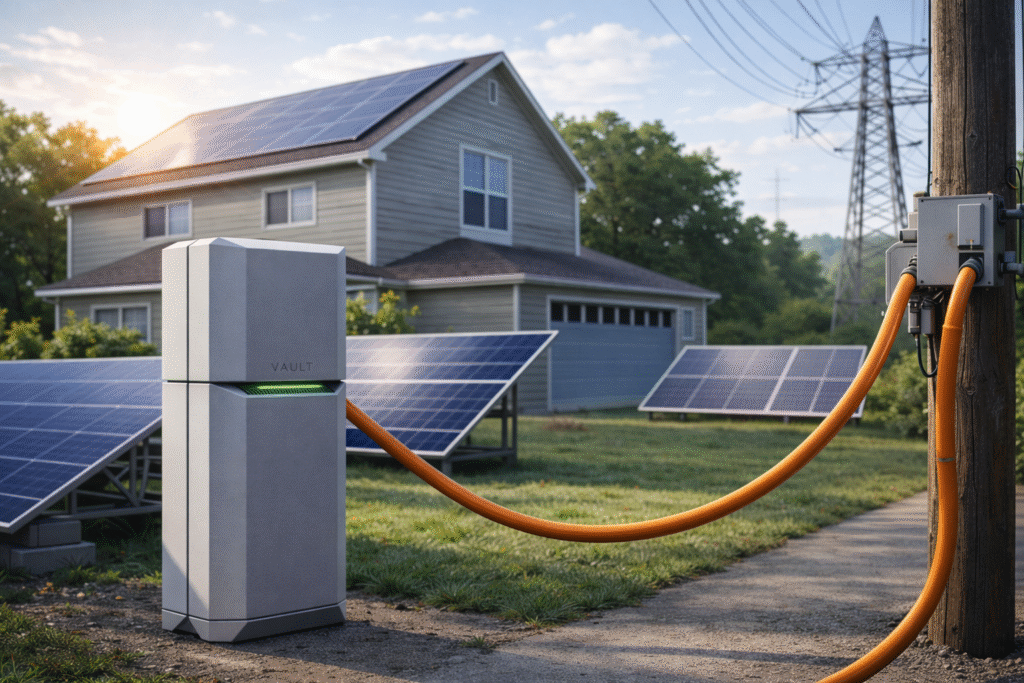
Most solar owners do not realise how much value they lose every day. They export electricity at midday when prices are weakest and buy it back in the evening at the highest rates. This is not a technical failure. It is a price-curve mismatch. A battery energy storage system fixes this by keeping surplus solar inside the home instead of releasing it to the grid at a discount.
Why export prices collapse at midday
Solar panels peak around noon. Thousands of homes generate electricity at the same time. When supply rises and demand is low, export compensation falls. This is normal market behaviour.
• midday supply is high
• grid demand is low
• export prices drop
In many European markets, export rates during these hours are only a fraction of retail electricity prices. Usable energy is handed over at minimal value.
Why exporting solar at noon loses value
Without storage, midday solar production is automatically exported. Because so many systems generate simultaneously, this “generation peak” pushes prices down. The result is simple. Solar owners sell electricity at the weakest prices and later repurchase energy in the evening when demand surges and prices rise. Solar production is zero at that time. This mismatch is the core economic weakness of solar without storage.
Why evening imports cost the most
Evenings bring the opposite conditions. Households cook, heat, charge devices, and run appliances. Solar output has dropped. System demand rises across the grid.
Retail prices follow.
• evening electricity is expensive
• grid stress increases tariffs
• solar owners buy back energy at peak prices
This is how value is lost quietly, day after day.
Real examples of the mismatch
The same pattern appears across multiple markets:• Italy: export tariffs often below €0.06 per kWh while evening retail prices exceed €0.25–0.40 per kWh
• Spain: midday surplus compensation can fall below €0.03 per kWh during high production periods
• Germany: small-system feed-in near wholesale levels while retail prices remain above €0.30 per kWh
• Finland and Sweden: export prices fall during solar peaks while evening tariffs rise due to congestion and demand
The structure is consistent: low export income, high evening cost.
Why BESS stops the value leak
A battery keeps midday solar power inside the home instead of sending it to the grid.
• surplus energy is stored, not exported
• stored energy replaces expensive evening imports
• peak-hour purchases are avoided
• solar generation creates direct savings instead of low-margin export revenue
Storage converts production into retained value..
Why this matters for long-term economics
Every kilowatt-hour exported cheaply is lost value. Every kilowatt-hour bought back at peak price is paid at a premium. A BESS breaks this cycle.
• It increases self-consumption.
• It reduces exposure to peak tariffs.
• It stabilises household energy costs.
• It protects the return on the solar investment.
For many homes, this shift determines whether a solar system pays back or slowly erodes in value.
Conclusion
You generate electricity during the cheapest hours of the day. You need electricity during the most expensive hours. Exporting is not a financial strategy. It is a donation. A battery stops the donation. It keeps your solar power where it has the highest value, inside your home.