
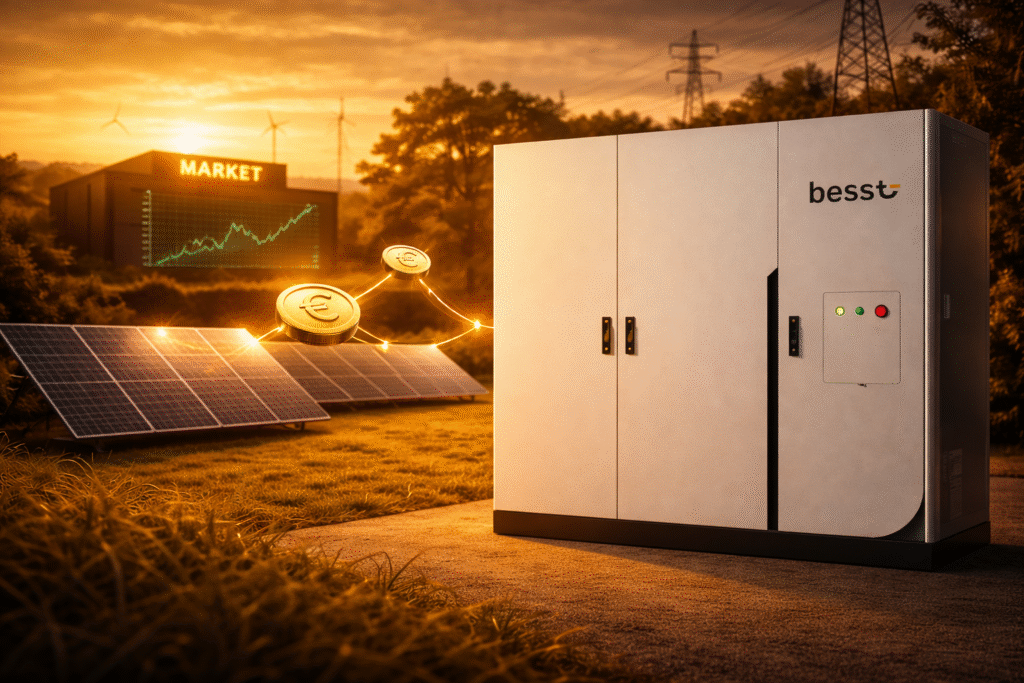
Most solar owners know how to save money. Few know how to earn it. Ancillary service markets, such as frequency regulation and balancing, were once accessible only to large power plants. Today, aggregated
home batteries can participate as well. Even small systems can earn when connected through a Virtual Power Plant (VPP). The household does nothing. The battery works automatically.
What ancillary markets actually are
Ancillary services keep the electricity system stable. They protect the grid from imbalances and frequency deviations. Grid operators pay assets that can react quickly and precisely.
The main categories include:
• frequency containment, providing fast response to stabilize grid frequency
• automatic reserves, adjusting power up or down in real time
• manual reserves, supporting the system during larger imbalances
These markets pay for availability, speed, and accuracy rather than energy volume.
Why one home battery cannot join alone
A single home battery, typically 5–10 kWh, is too small to qualify for these markets. Grid operators require minimum power thresholds that individual households cannot meet. However, thousands of small batteries combined can form a resource larger than a conventional power plant.
How aggregation solves the size problem
A Virtual Power Plant connects home batteries through centralised software. Instead of many small systems, the aggregator submits one combined asset to the market. For the grid operator, it behaves like a single flexible resource. For the household, participation requires no effort:
• no trading
• no scheduling
• no technical management
• no manual control
The VPP operator manages market participation and distributes earnings to participants.
Where the money comes from
A home battery connected to a VPP can earn from several sources:
• capacity payments for being available to respond• charging or discharging when the grid requires balance
• frequency stabilisation services that reward fast response
• absorbing excess renewable generation during surplus periods
These are established market mechanisms across Europe, driven by the growing need for flexibility as renewable penetration increases.
Why Participation Does Not Affect Daily Use
VPP operation is designed around household priorities. Typical safeguards include:
• reserving sufficient capacity for evening household use
• limiting cycles to protect battery health
• preserving backup power where available
• fully automated control
The household continues using electricity normally. The battery contributes small, rapid adjustments that remain invisible to the user.
Why earnings are realistic even for small systems
Even a 5–10 kWh battery creates value when aggregated:
• it contributes a share of available power
• it participates in short-duration control actions
• it delivers precision that grid operators pay for
• earnings are proportional to contribution
The income is not comparable to utility-scale assets, but it is a genuine revenue stream added on top of solar savings. Solar-only systems cannot access this value.
Why this matters for solar owners
Solar generation reduces electricity bills. A battery increases savings. A battery connected to a VPP can also earn income by supporting the grid. This transforms a passive solar installation into an active grid asset.
Conclusion
Ancillary markets are no longer reserved for large companies. Aggregation allows thousands of home batteries to operate together as one coordinated resource.
Your battery supports the grid automatically, and you earn a share of the value created.
Solar reduces costs.
Storage increases returns.
Aggregation creates new income.