
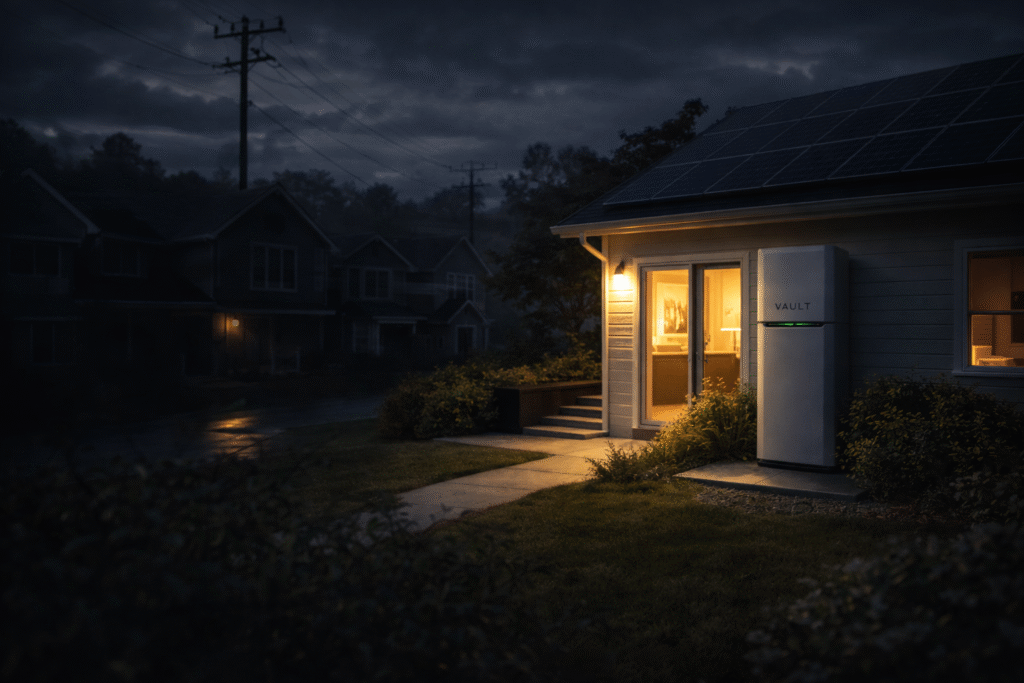
Households install batteries because they want long-term financial
stability. A BESS reduces exposure to peak tariffs, preserves the value of
solar generation, and protects the home from price spikes and policy
changes. Over ten to twenty years, these steady daily savings
accumulate. This makes a BESS the closest practical equivalent to a
personal pension mechanism operating inside the home.
Why households need long-term financial protection
Electricity is one of the most unstable household expenses. Prices change hourly. Peak tariffs rise.
Grid fees adjust. Export rates fall. Policies evolve.
A BESS acts as a protective mechanism. It does not remove volatility, but it shields the household
from the most expensive and unpredictable parts of it. This mirrors the role of traditional pension
schemes, which exist to reduce long-term financial risk rather than eliminate uncertainty.
Why daily savings behave like pension contributions
A battery delivers value in small, continuous increments:
• avoided peak-hour imports
• increased use of self-generated solar
• reduced evening grid consumption
• lower sensitivity to sudden price spikes
• more predictable monthly bills
Each benefit is modest on its own. Accumulated daily over many years, the financial impact
becomes significant. This is the same principle behind pension systems: consistent, incremental
value building over long periods.
Why BESS creates predictable long-term energy costs
Without storage, a household is fully exposed to the market price at the moment electricity is
consumed.
With storage, more energy is drawn from stored or self-generated sources during expensive hours.
Less electricity is purchased when prices peak. Low-value daytime solar exports are reduced.
The result is a more stable and controlled cost structure, which is exactly the financial behaviour
households expect from long-term protection instruments.
Why BESS protects the value of solar investments
Many solar owners lose value because surplus energy is exported at low rates and repurchased
later at high evening prices. This erodes payback and weakens the original investment.
A battery changes this dynamic. Surplus solar is stored and used when its value is highest. Evening
imports decline sharply. The economic return of the solar system is preserved.
This is asset value protection, the same function pension instruments perform for long-term
savings.Why BESS functions as a private financial buffer
A BESS protects households from:
• tariff changes
• peak-hour price escalation
• unstable export rates
• local grid disturbances
• rising electricity demand from EVs and heat pumps
• long-term upward price trends
It does not replace the grid. It reduces dependence on the most expensive and volatile parts of it.
Over time, this creates a durable financial buffer that compounds benefits year after year.
Why households treat BESS as a long-term personal asset
A battery matches the characteristics people associate with pension-like tools:
• automatic operation
• incremental daily value
• long-term consistency
• reduced exposure to external shocks
• protection of existing investments
• predictable medium- and long-term outcomes
This is why BESS adoption grows fastest among households that plan long-term rather than chase
short-term gains.
Conclusion
Solar panels generate value.
A battery preserves it.
Electricity markets are volatile.
A battery stabilises household exposure.
Policies change.
A battery cushions the impact.
Over years, these small daily corrections accumulate, just as pension contributions do.
A BESS is not a luxury upgrade.
It is one of the most practical long-term financial stabilisers a household can install.