
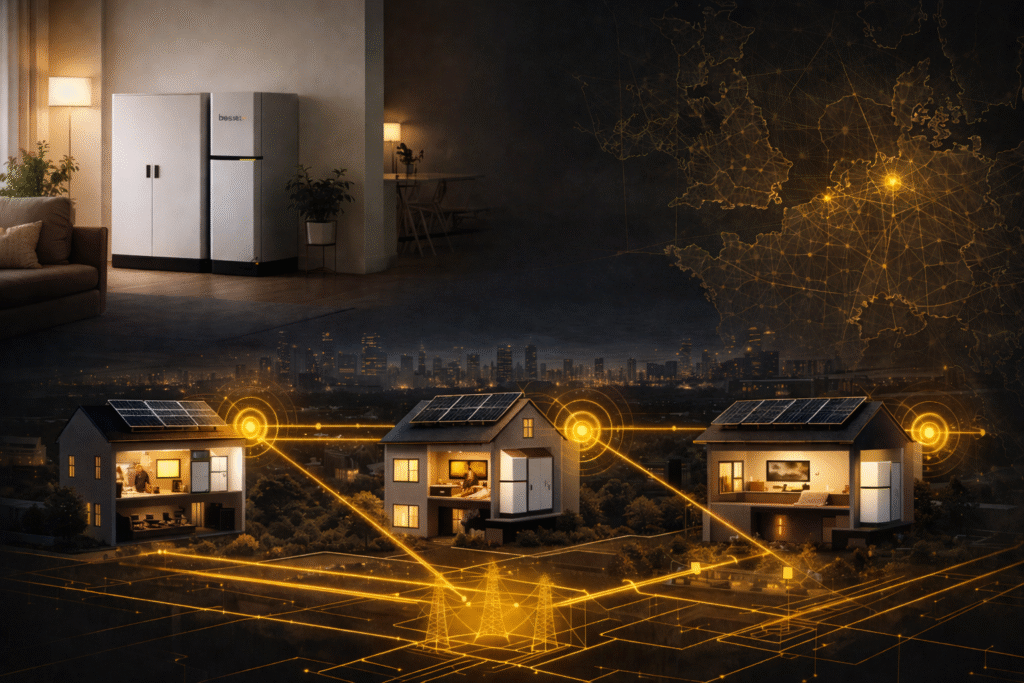
Europe is moving from centralised electricity generation toward distributed energy systems installed in millions of homes. Individually, solar panels, batteries, and electric vehicles are small assets. Aggregated together, they form a fast, flexible power resource that rivals large conventional power plants in scale and exceeds them in responsiveness. These assets scale rapidly, react faster than traditional generation, and stabilise the grid with high precision. Households are becoming Europe’s hidden power plant.
Why distributed power is rising
Rooftop solar installations across Europe continue at record pace. Residential battery adoption grows each year. Heat pumps increasingly replace fossil boilers. Electric vehicles are becoming standard household assets. Each installation adds:
• local generation or storage capacity
• controllable demand
• the ability to shift energy across time
From the grid’s perspective, households are no longer passive consumers. They are active system participants. This fundamentally changes how the electricity system operates.
Why households become a flexible resource
Europe is moving from centralised electricity generation toward distributed energy systems installed in millions of homes. Individually, solar panels, batteries, and electric vehicles are small assets. Aggregated together, they form a fast, flexible power resource that rivals large conventional power plants in scale and exceeds them in responsiveness.
These assets scale rapidly, react faster than traditional generation, and stabilise the grid with high precision. Households are becoming Europe’s hidden power plant.
Why aggregation beats traditional generation
Traditional power plants are centralised, slow to ramp, and capital-intensive. Distributed assets are already installed, geographically spread, and digitally controllable.
When aggregated, they provide:
• rapid-response flexibility
• peak load reduction
• frequency stabilisation
• local congestion relief• energy shifting across time
• bidirectional operation
In many system conditions, aggregated household assets deliver higher operational value than conventional generation units.
Why households will dominate capacity growth
Europe’s climate and energy targets require large volumes of flexible capacity. Utility-scale generation alone cannot meet this need. New plants take years to permit and build. Grid reinforcement progresses even more slowly.
Distributed assets, however, are already connected and continue to scale rapidly:
• rooftop solar
• home batteries
• electric vehicles with smart charging
• heat pumps operating on dynamic tariffs
The combined flexible capacity of these assets is expanding faster than any single utility project in Europe.
Why the hidden power plant is unstoppable
The structure is straightforward.
• Households generate.
• Households store.
• Households shift demand.
• Households stabilise the system.
• Households earn from flexibility.
No single power station can scale this quickly or operate with this level of precision. The future electricity system will not be built in one location. It will be built across millions of homes.
Europe’s largest power plant will not appear on a map. It will be distributed across the continent.