
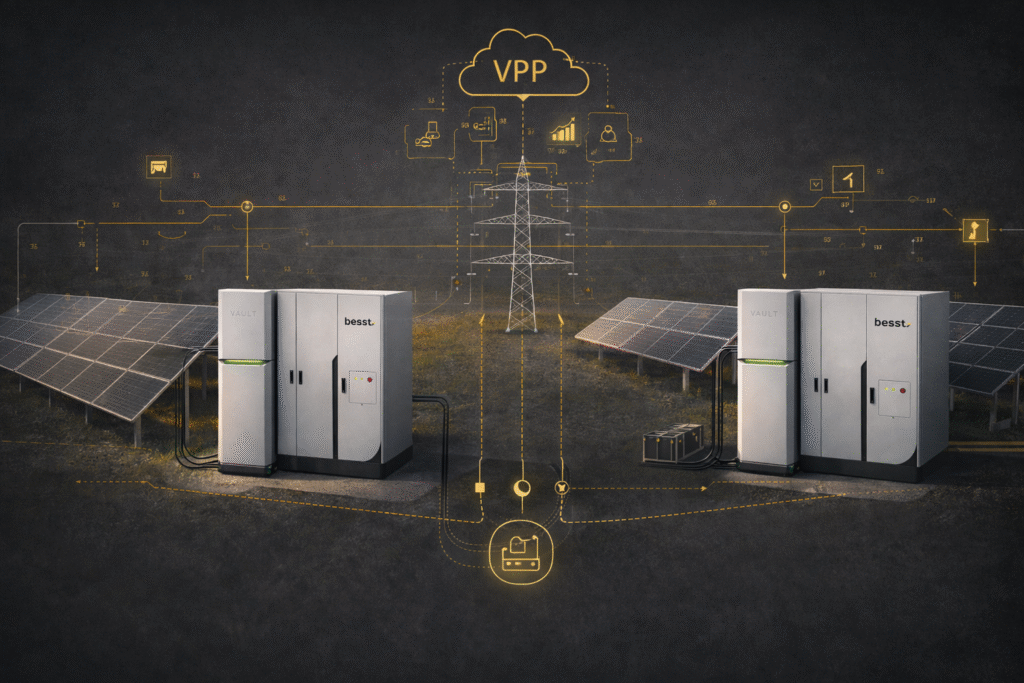
A Virtual Power Plant is a digitally coordinated network that aggregates many small, distributed energy devices and operates them as a single large asset. These devices typically include home batteries, rooftop solar systems. Centralised software coordinates their operation, allowing the aggregated system to respond to grid needs in real time.
Why one battery has limited standalone value
A typical home battery provides 5-10 kWh of storage and around 3-5 kW of power. This is enough for household optimisation but not enough to enter:
• frequency control markets
• balancing services
• capacity availability markets
• demand-side response programs
Grid operators require minimum thresholds, often around 1 MW or more. No single household system can meet that. This is the fundamental reason small batteries cannot earn alone.
How a VPP multiplies the value of small systems
A Virtual Power Plant aggregates thousands of home batteries through software and control hardware. Instead of many small systems, the grid sees: one large, coordinated asset. This enables:
• market entry at industrial scale
• fast-response actions across a distributed fleet
• higher precision than large centralised plants
• access to payments unavailable to individual households
Your 5 kW system becomes part of a multi-megawatt flexibility resource.
Where the additional profit comes from
A battery inside a VPP can earn from services that pay for flexibility, not energy. These include:
• FCR (frequency containment)
• aFRR / mFRR (restoration reserves)
• capacity availability payments
• local flexibility markets run by DSOs• absorbing surplus renewable generation when required
The household receives a share of the aggregated earnings based on its contribution. This is incremental revenue on top of self-consumption savings.
Why community improves total system efficiency
A distributed fleet delivers three structural advantages:
• speed: home batteries react within milliseconds
• granularity: micro-adjustments distributed across thousands of units
• resilience: no single point of failure
Grid operators value this because it stabilises the system more effectively than a single centralised unit. The better the fleet performance, the higher the market value.
Why revenue becomes predictable at fleet scale
Individual batteries vary in usage patterns. Aggregated fleets do not. Thousands of systems behave like one smooth asset:
• predictable availability
• predictable capacity
• predictable response profile
This stability makes VPPs competitive in ancillary markets and allows aggregators to forecast earnings more reliably. Predictability → higher participation → consistent revenue.
Why solar owners benefit most
Solar reduces bills. A battery increases the value of solar, a battery inside a VPP adds a third layer:
• additional income while you sleep
• participation in regulated grid services
• monetisation of flexibility you already own
Solar-only systems cannot do this. Even solar + storage alone cannot do this.
Conclusion
A home battery is useful but a home battery inside a coordinated community storage network is
valuable. A VPP unlocks markets that were previously reserved for utilities and large power stations. It turns
thousands of small systems into one profitable fleet, creating new earnings on top of solar savings.
• Solar saves money.
• Storage increases savings.
• Community storage creates shared profit.