
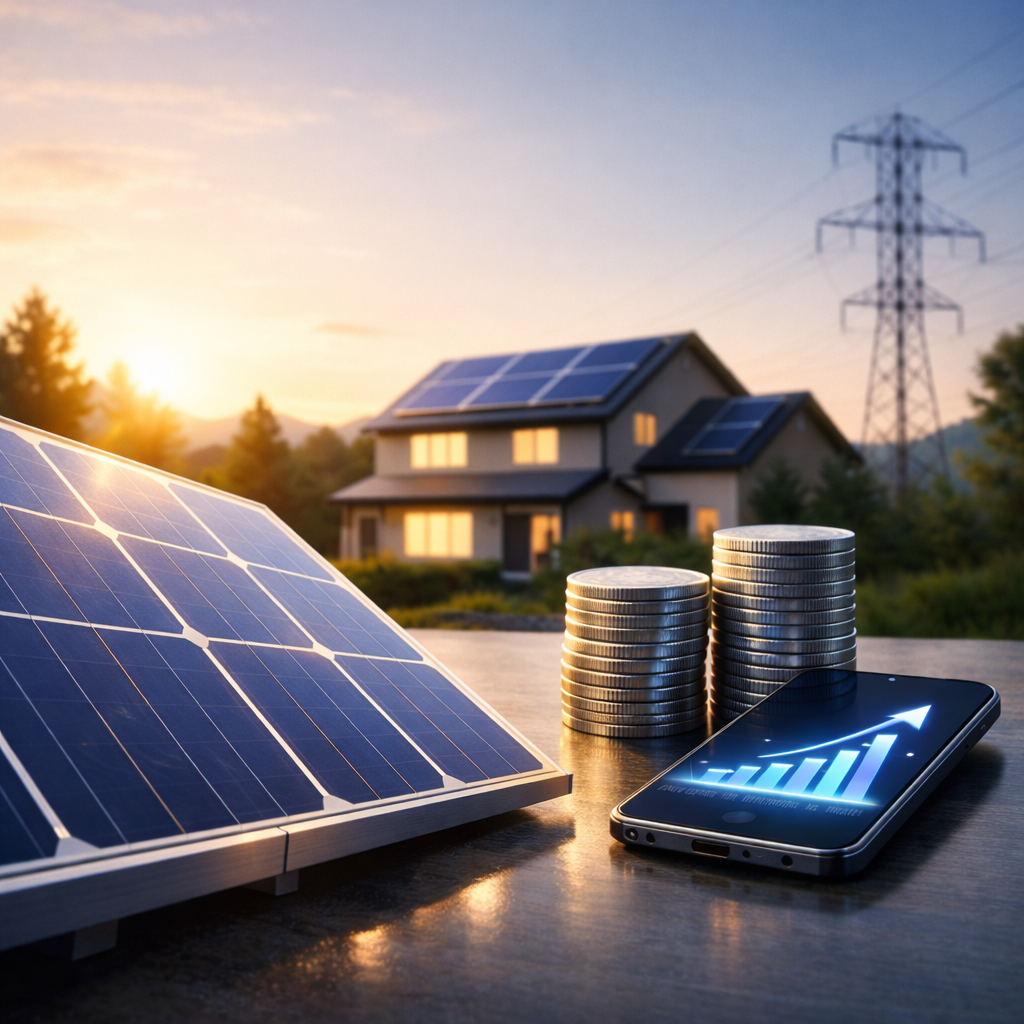
Solar panels are effective at reducing electricity bills. On their own, however, they rarely generate income. That changes when solar is combined with a home battery and participation in a Virtual Power Plant (VPP). Together, these elements turn a household from a passive consumer into an active market participant. Instead of only saving money, the system begins to earn it by providing flexibility and grid services.
Why solar alone cannot earn monthly revenue
Solar panels produce electricity during daylight hours, but the grid pays little for midday exports. Most households receive only a small credit for surplus energy because:
• export prices fall when solar production peaks
• feed-in tariffs are well below retail prices
• solar systems cannot provide grid services on their own
Solar reduces bills, but it does not create recurring income.
Why adding a battery changes the economics
A battery stores the solar energy that would otherwise be exported at low value. This increases self-consumption and reduces evening imports. More importantly, a battery enables participation in flexibility markets that require fast and controllable response. Solar alone cannot meet these requirements. With storage, the home becomes capable of:
• delivering power on demand
• absorbing excess grid energy
• participating in reserve services
• providing balancing capacity
This shifts the household from pure savings toward potential earnings.
What a Virtual Power Plant actually does
A Virtual Power Plant is a software platform that aggregates thousands of small batteries into one coordinated resource. Instead of one large storage facility, the grid interacts with a distributed fleet. For the household, this means:
• no manual operation
• no direct market trading
• no technical complexityThe VPP operator manages market participation. The household receives a share of the revenue based on its contribution.
Where the actual revenue comes from
A home battery connected to a VPP can earn from multiple value streams:
• FCR for rapid frequency response
• aFRR and mFRR for balancing energy
• capacity availability payments for being ready to respond
• absorption of excess renewable generation
• export at high-value moments, timed by the VPP
These markets pay for availability, speed, and precision, not just energy volume. A single home battery cannot access them alone, but aggregated through a VPP, it can.
Why this is real democracy in energy
Traditional energy systems were centralised. Only large utilities earned from grid services. A VPP distributes participation across thousands of households:
• many small systems
• shared access
• earnings linked to contribution
• decentralised participation
Households become active contributors to system stability rather than passive bill payers.
What the monthly revenue looks like
Actual earnings depend on:
• national market rules
• battery size and performance
• VPP operator model
• usage patterns and availability
The structure, however, is consistent:
• solar reduces costs
• storage avoids expensive imports
• VPP participation adds recurring income
This is how a solar installation evolves from a cost-saving measure into a system with a monthly
revenue component.
Conclusion
• Solar alone reduces bills.
• Solar plus storage increases value.
• Solar plus storage plus VPP participation creates recurring revenue.
This is the transition from passive consumption to active participation. This is how households begin earning from the same electricity system they once only paid into.