
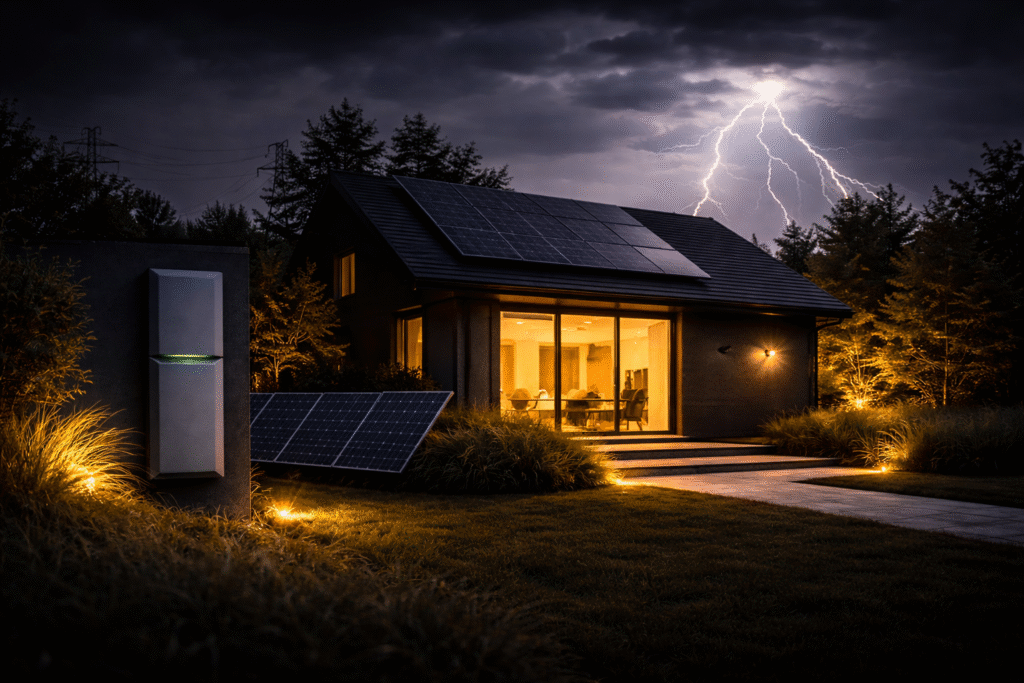
Many homeowners believe solar panels protect their home during blackouts. They do not. When the grid fails, almost all residential solar systems shut down automatically. Without storage, the home loses power even on a sunny day. A battery changes this. It provides local power when the grid is down and keeps essential loads running. Recent large-scale outages across Europe made this clear: solar alone is not backup power.
Why solar panels shut down during an outage
Most residential solar systems use grid-tied inverters. These are required to follow anti-islanding rules.
If:
• grid voltage drops
• grid frequency collapses
• a line fault is detected
• or the grid disconnects
the inverter must stop producing electricity.
This is mandatory to protect line workers and prevent uncontrolled islanded systems from feeding damaged lines.
The result is simple:
no battery means no power during a blackout, even under full sunlight.
Why this became visible during recent European outages
Recent large outages, including events in Spain, exposed a reality many homeowners had never experienced:
• solar installations shut down instantly
• homes without storage lost all power
• essential services stopped
These events highlighted a structural fact. Solar-only systems are fully dependent on the grid.
When the grid goes down, solar becomes unusable until it returns.
What a battery changes
A battery system with backup capability allows the home to operate independently during a grid failure.
Key functions include:
• safe islanding from the grid
• supplying selected circuits
• smoothing short load spikes
• stabilising voltage for sensitive electronics
During daylight, solar panels continue charging the battery and powering the home. This is the difference between a full blackout and maintaining essential services.
What “essential loads” actually mean
A properly configured battery backup can power:
• lighting
• internet and communications
• refrigeration
• medical equipment
• security systems
• essential electronics
• circulation pumps
• phone and laptop charging
This is not luxury. It is operational need.
Why grid outages are increasing
Across Europe, outage risk is rising due to:
• increasing peak demand
• extreme weather events
• ageing distribution networks
• Local grid congestion
• pressure from variable generation
Solar alone does not address these risks. Storage does.
Why this matters for solar owners
Solar-only households face three blackout problems:
• the system shuts down immediately
• no solar energy can be used
• evening outages leave no power source
A battery resolves all three.
Conclusion
Solar panels reduce electricity costs but do not provide resilience. When the grid fails, solar fails with it. A battery keeps essential loads running, enables controlled islanding, and turns a solar installation into a true power asset, even when the surrounding system goes dark. Solar reduces costs, Storage protects the home.