
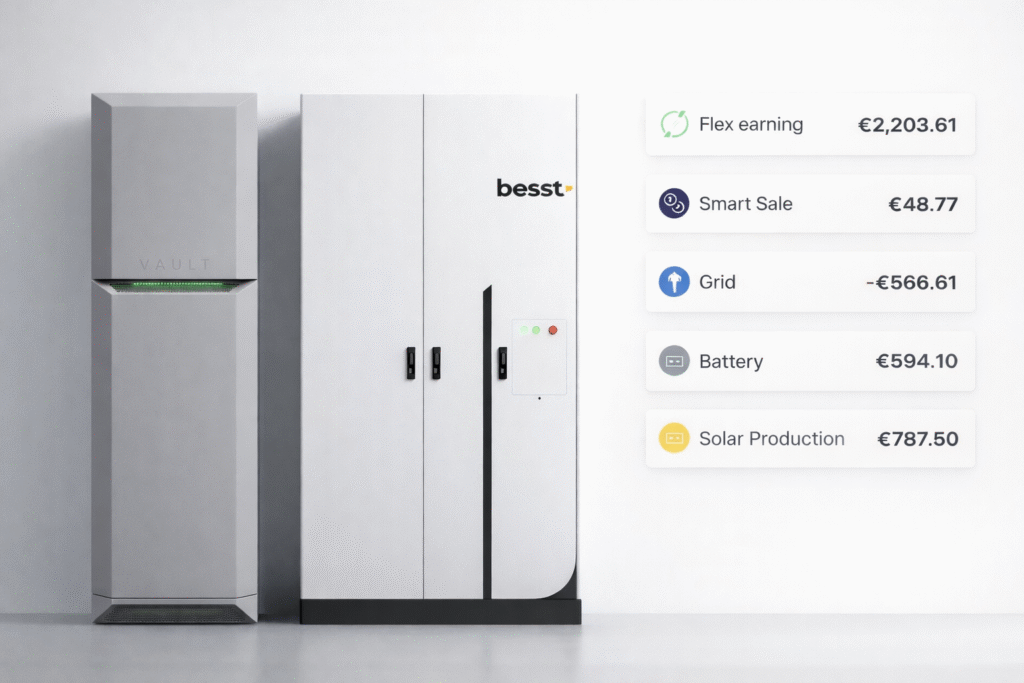
These results come from a real operating household battery system over a fixed period: July 1, 2025 – December 31, 2025. Six months of realized value.
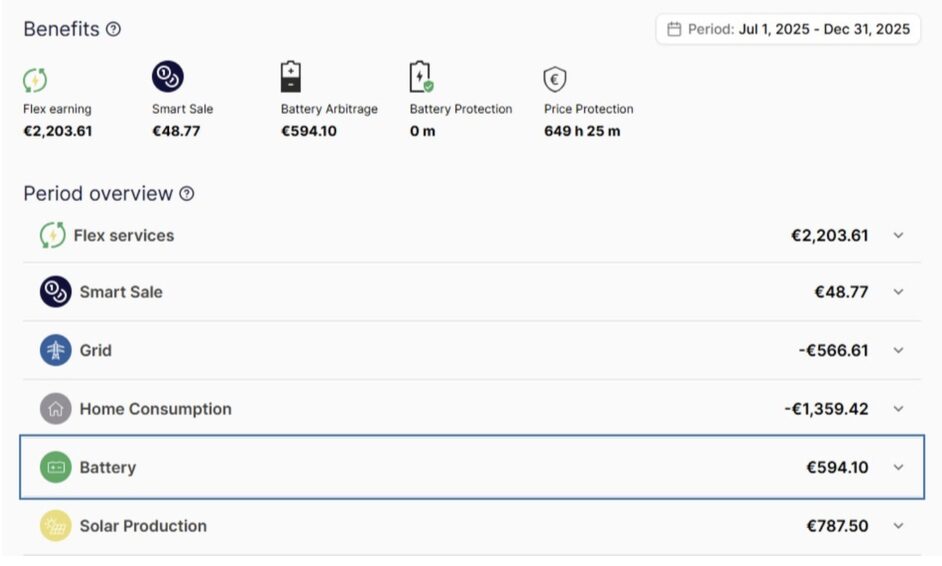
Where the profit comes from (what each line means)
1) Flex services: €2,203.61 (main revenue)
The battery gets paid for supporting the grid:
• provides availability and fast response power
• charges/discharges when the system needs balancing
• supports frequency stability
It is payment for delivered grid service, fully automated by software.
2) Battery arbitrage: €594.10 (price spread profit)
The battery earns from the electricity price difference:
• charges when prices are low
• discharges when prices are high
• avoids peak grid imports
This value repeats daily and accumulates over months.
3) Smart Sale optimization: €48.77 (export control)
Small, but important:
• exports only when prices justify it
• avoids exporting during weak pricing windows
This prevents constant value leakage.
4) Solar value retained: €787,50 (avoided cost)
Solar energy that was:
• stored and used later
• not sold cheap midday
• not repurchased expensive in the eveningNot “cash income”, but money saved, financially equivalent.
The result is stable because value comes from stacking:
• grid service revenue
• price spread capture
• export optimisation
• solar shifting
Scaling to 30 kWh AIO
Using 30 kWh household system as an average benchmark, the same stacking scales with capacity. A 30 kWh AIO system delivers about +50% higher total value over the same Jul–Dec window. Expected 6-month stacked value for 30 kWh AIO: ~€5,450.98