
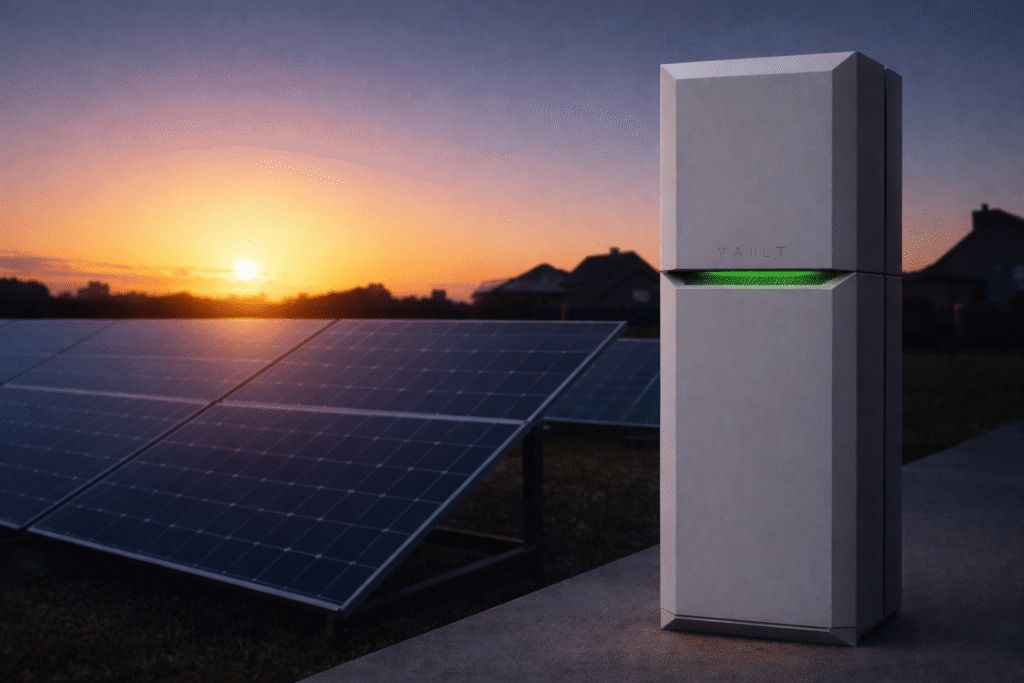
Solar panels work on their own schedule. They generate most of their electricity in the middle of the day. Households, however, consume most of their electricity in the evening. This mismatch is responsible for the loss of value in most solar installations. A battery eliminates this gap by storing daytime surplus and delivering it when the household actually needs it.
Why solar peaks at the wrong time
Solar production follows the sun, not daily household routines. Output rises in the late morning, peaks around midday, and declines in the afternoon. This is driven by physics. Panels produce when sunlight is strongest. Household consumption follows a different pattern. Cooking, heating, entertainment, EV charging, and appliance use peak later in the day, often when solar production has already dropped to zero.
Why exporting solar at noon loses value
Without storage, midday solar production is exported to the grid. Export prices during these hours are usually low because thousands of households generate electricity at the same time. This
simultaneous output pushes prices down. As a result, the household sells electricity at minimal value during the day and buys it back in the evening when demand rises and prices are higher. This imbalance is the core economic weakness of solar without storage.
How storage unlocks the full value of solar
A battery captures surplus electricity during midday production and stores it for later use. Instead of exporting low-value energy, the household uses it during high-tariff evening hours.
This delivers three direct benefits:
• higher self-consumption
• fewer expensive grid imports
• improved return on the solar investment
Storage does not increase generation. It increases value.
Why this simple shift changes everything
The daily pattern remains constant:
• production peaks when value is low
• demand peaks when value is high
A battery realigns this pattern at the household level. Consumption is matched with self-generated energy rather than grid price peaks. Over time, this reduces volatility, stabilises electricity costs, and protects the long-term economics of the solar system.
Conclusion
Solar alone produces energy when the household needs it least. Storage allows that energy to be used when its value is highest. By closing the gap between production and consumption, a battery preserves the full value of solar generation and turns it into a reliable household asset.