
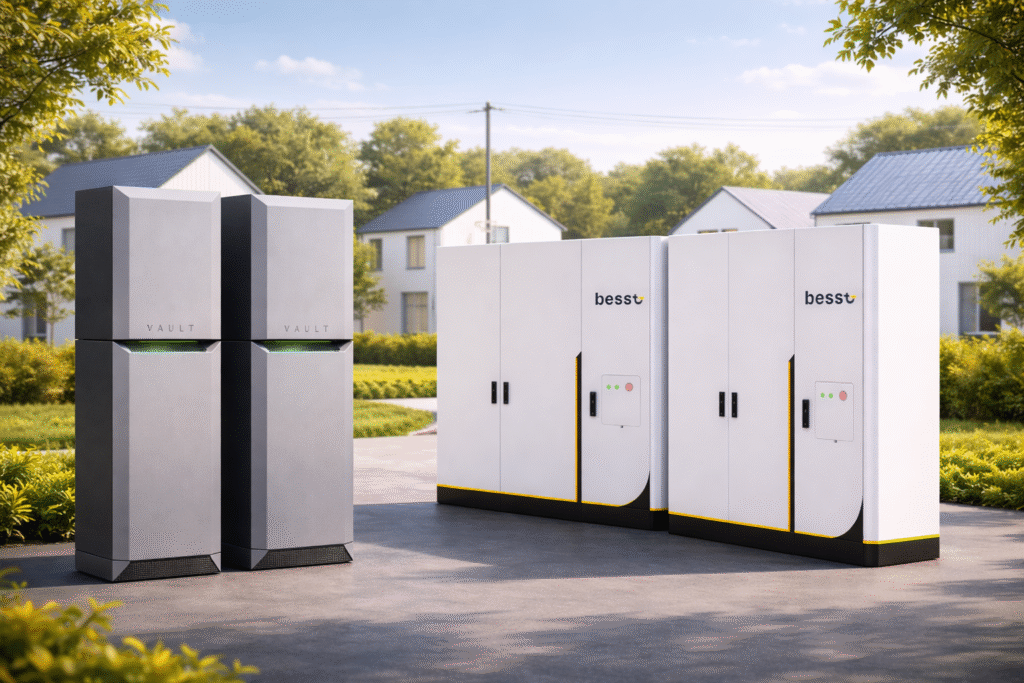
For decades, households have lived inside an energy system they don’t control. Electricity is something people depend on, but rarely influence. Prices move without warning, rules shift overnight, outages happen – and when they do, people are simply expected to adapt.
The BESST community model flips that dynamic. It gives power back to households. Not just technically, but in the way that matters: control, stability, and a fair share of the value in a market households have funded for years, without truly benefiting from.
From adapting to shaping outcomes
A single home battery already changes daily life. It stores energy when it’s cheaper, supports you when the grid is strained, and keeps essential loads running when the lights go out. But on its own, a household is still small in a much larger system. One family can’t shape outcomes, one battery can’t move markets, and one home can’t create stability for anyone else. That’s the real shift BESST introduces: scale through community.
Mutual protection:
strength that spreads A distributed community of batteries protects everyone better because the system no longer depends on one point of failure. If one unit drops out, others absorb the load. If one street becomes unstable, the network responds from the nearest available capacity. Its resilience spread across many homes, many businesses, not concentrated in a single asset. This is mutual protection: fewer weak points, faster response, stability where people actually live, and failures absorbed by the community instead of being carried by one household.
Fair access to income
This is where the model becomes more than security. This is where it becomes fair. For decades,households paid for stability they did not control. Power plants made money providing it, grid operators relied on it, markets priced it in, but ordinary people never got a share of it. The BESST community model changes that. Individually, a battery can lower your bill and protect your home, but it can’t create meaningful market value on its own. As a community, it becomes a flexible resource large enough to participate in energy markets and grid services that were once reserved for major infrastructure players. And that creates income – real value generated by contributing to grid stability and system performance. If you help stabilize the system, you share in the upside. That’s the point.
The first true public energy company
This isn’t “energy independence” in the sense of disconnecting from the grid. It’s independence in the sense of not being powerless inside it. The BESST community is like the first true public energy company – owned by the people who power it. Households stop being passive consumers and become stakeholders, contributors, participants. They don’t just pay for stability. They help provide it, and they earn from it.
Energy designed around people
In the end, the BESST community model isn’t about only technology, It’s about uniting everyone for achieving quieter living, less stress about outages, protection from volatility, shared strength, shared economic value. Energy stops being a burden people fear. It becomes something that works in the background while life continues normally. Energy should empower people. That’s what the BESST community model is built for.