
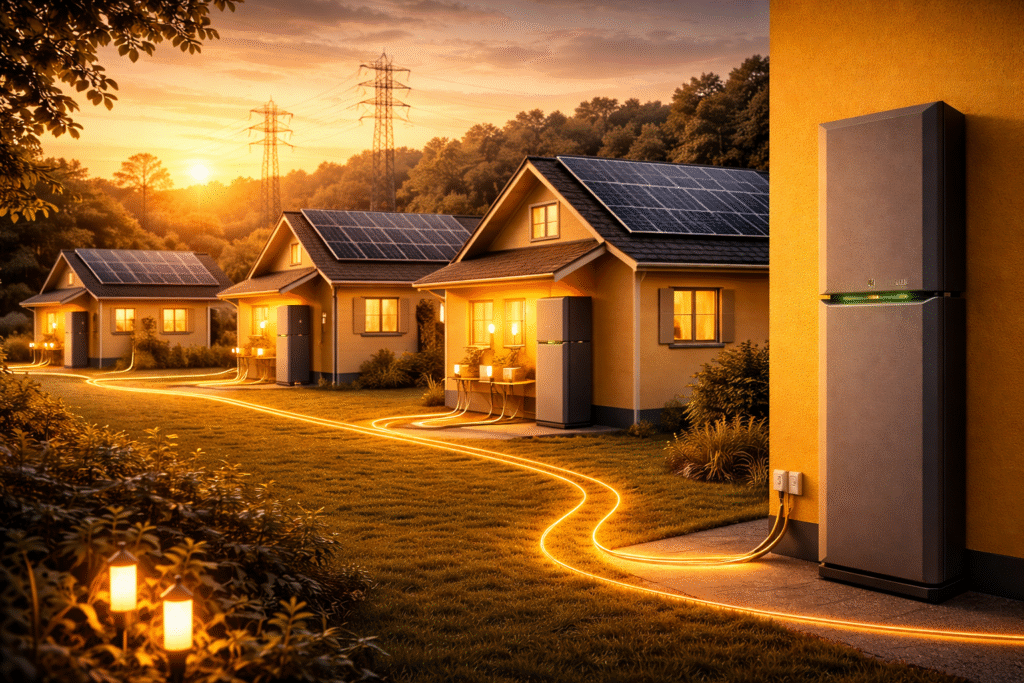
Distributed batteries installed in homes and businesses are becoming a stronger system asset than large centralized storage plants. They
deploy faster, require less capital concentration, avoid land constraints, improve local resilience, and reduce investor risk. When aggregated, fleets of small batteries deliver more strategic value to the grid than a single large installation.
Why distributed storage is faster to deploy
Large storage plants require environmental permits, land acquisition, grid impact studies, construction work, and regulatory approval. This process often takes years.Residential and commercial batteries require none of this. Installation takes hours, and thousands of systems can be deployed in parallel. Speed is a structural advantage, and distributed storage benefits from it directly.
Why distributed storage has lower cost per installed kilowatt
Centralised plants concentrate capital in one location. Costs include land purchase or leasing, civil works, foundations, fencing, on-site safety systems, high-voltage equipment, grid upgrades, and dedicated operations. Distributed batteries avoid these costs. The building already exists. The grid connection already exists. There is no land cost and minimal civil engineering. As a result, the cost per installed kilowatt of usable flexibility is lower.
Why distributed storage avoids land use and transmission bottlenecks
Large plants must be located near substations or transmission corridors. Suitable land is limited, expensive, and often politically sensitive. Distributed storage requires no new land and connects directly at the point of consumption. This allows storage to relieve congestion exactly where it occurs. A single central plant cannot resolve thousands of local grid constraints.
Why distributed storage increases system resilience
A large storage plant is a single point of failure. If it goes offline, all capacity is lost at once. A distributed fleet is inherently resilient. Individual unit failures do not affect system operation. As fleet size grows, resilience increases. Distributed batteries also provide backup value to households and small businesses during short outages, which centralized plants cannot do.
Why distributed storage reacts faster
Grid stability services require rapid response. Distributed batteries deliver instant reaction at the device level. Aggregation software coordinates thousands of units as a single controllable asset, matching or exceeding the response performance of centralized plants. Faster response improves both technical stability and market value.Why investment risk is lower A centralised plant concentrates capital in one project. Regulatory changes, market shifts, or permitting issues affect the entire investment at once. Distributed storage spreads risk across thousands of independent systems. Revenue is diversified across locations, users, and grid conditions. This reduces concentration risk and improves long- term investment stability.
Why distributed storage is strategically superior
Distributed storage deploys faster, costs less per installed kilowatt, requires no land, strengthens resilience, reduces transmission congestion, reacts instantly, and spreads investment risk. Centralised plants still play a role in bulk capacity, but they cannot match the flexibility, speed, or system value of distributed fleets. Europe’s energy system is moving toward decentralisation because it is economically and strategically stronger.