
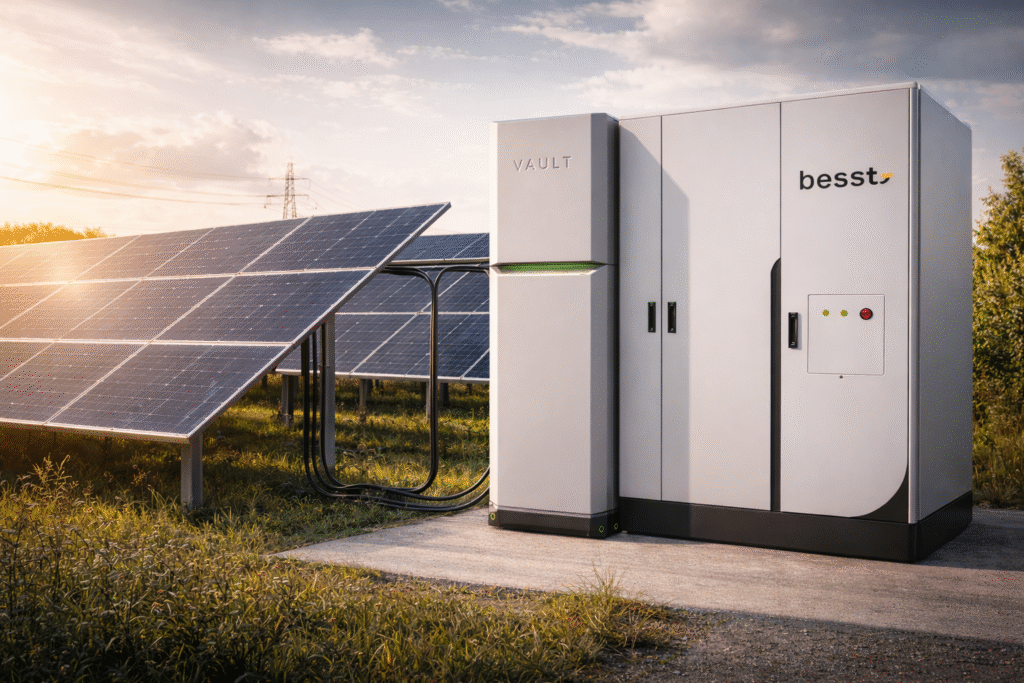
Most households with rooftop solar use only a small share of the electricity they generate. In a typical European home, self-consumption averages around 25–35%. The remaining energy is exported to the grid at low prices. A battery changes this dynamic. It increases self-consumption to 80–90%, which fundamentally improves return on investment. Solar ROI is driven not by how much energy is produced, but by how much of that energy the household keeps at full value.
Why low self-consumption weakens solar ROI
Solar panels produce the most electricity when household demand is lowest. As a result:
• large midday surpluses are exported
• export prices often fall to 0.03–0.10 €/kWh
• evening imports cost 0.25–0.45 €/kWh
• the system sells low and buys high
With self-consumption near 30%, most of the value created by the system leaks into the grid at a discount.
Why raising self-consumption transforms ROI
A battery stores surplus solar production during the day and releases it in the evening. This sharply increases self-consumption. Typical European outcome:
• solar only: 25–35%
• solar plus battery: 80–90%
This shift improves economics because:
• fewer kilowatt-hours are exported at low prices
• more kilowatt-hours replace expensive imports
• each retained unit delivers higher financial value
ROI improves not because production increases, but because value retention increases.
Why the improvement is so large
Consider a household producing 5,000 kWh per year.
• at 30% self-consumption, about 3,500 kWh are exported
• at 80–90%, only 500–1,000 kWh are exported
This shifts approximately 2,500–3,000 kWh per year from low-value export to avoided imports.With a typical price spread of around 0.20 €/kWh, the additional retained value is roughly 500–600 € per year. This is the core driver of improved ROI.
Why the math favors storage
In markets with:
• low export compensation
• high evening tariffs
• time-of-use pricing
• strong peak-hour differentials
raising self-consumption from 30% to 80–90% can increase the effective return of a solar installation by 40–70%. In favourable conditions, total system ROI can approach double that of solar-only installations. This improvement comes from value retention, not speculation, subsidies, or incentives.
Why this remains true even with battery costs
A properly sized battery delivers stable long-term value even after accounting for:
• battery investment cost
• installation
• efficiency losses
• gradual degradation
As long as local tariffs follow common European patterns, the additional annual value from higher self-consumption offsets storage costs over the system’s lifetime.
Conclusion
Solar produces energy. Storage captures its value. Raising self-consumption from around 30% to 80–90% changes the economics of solar fundamentally. The household avoids low-value exports, reduces exposure to peak tariffs, and stabilises long-term returns. Solar alone cuts part of the bill. Solar plus storage unlocks the full return.