Maxim Evtushenko

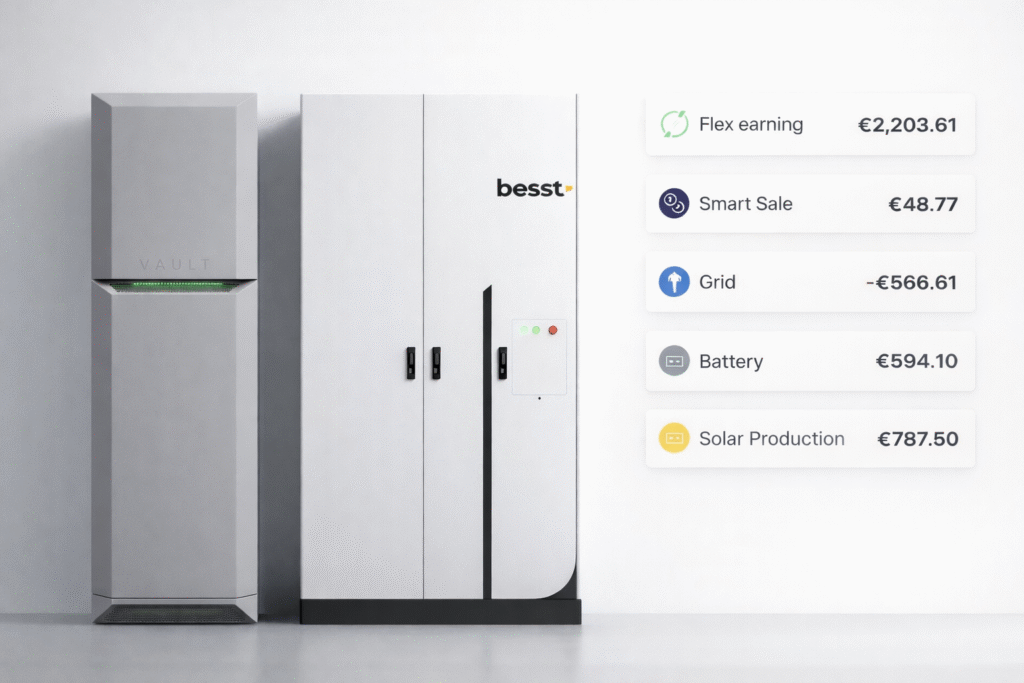
Two realistic battery storage systems standing side by side in a clean white studio environment. On the left is a tall grey unit labeled “VAULT” with a subtle green LED strip, and on the right a larger white cabinet labeled “besst” with a small control panel. To the right of the batteries, minimal UI-style panels display financial figures: Flex earning €2,203.61, Smart Sale €48.77, Grid -€566.61, Battery €594.10, and Solar Production €787.50.

Real Battery Profit Breakdown From Live Data

These results come from a real operating household battery system over a fixed period: July 1, 2025 – December 31, 2025. Six months of realized value. Where the profit comes from (what each line means) 1) Flex services: €2,203.61 (main revenue) The battery gets paid for supporting the grid: • provides availability and fast response […]

Real Battery Profit Breakdown From Live Data Read More »
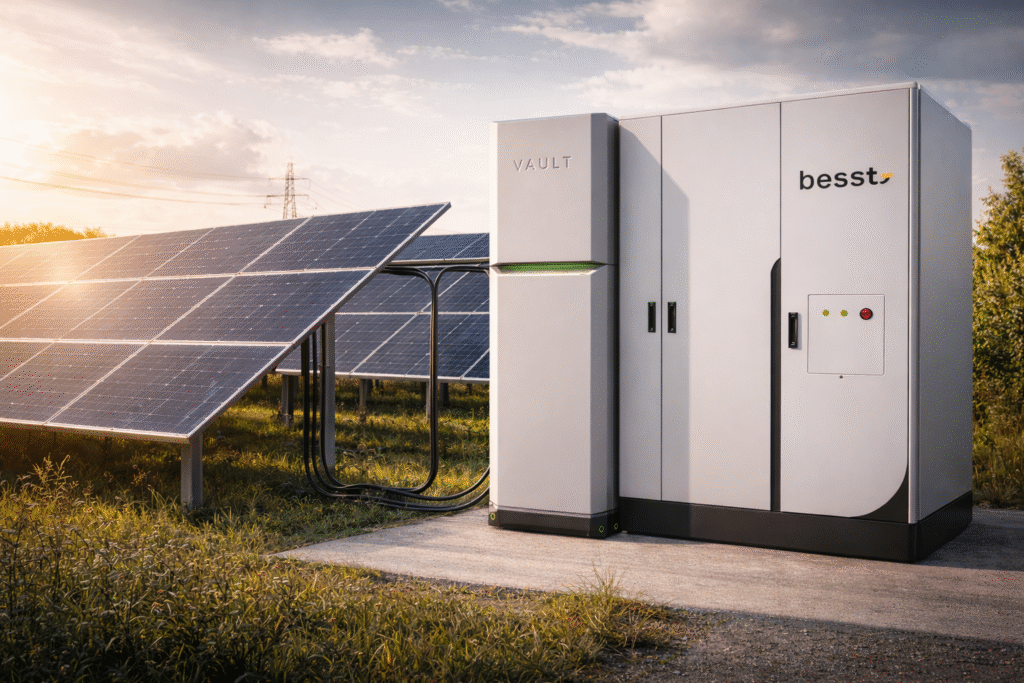
High-end editorial photograph of a ground-mounted solar array at golden hour connected to two energy storage units. In the foreground, a sleek VAULT battery with embossed “VAULT” text positioned near the upper front panel stands beside a larger besst-branded cabinet in black and yellow accents. Thick black cable routing runs cleanly from the rear of the solar panels into the ESS units, clearly showing system integration. A faint transmission tower and power lines are visible in the distant background, implying grid participation. The scene is ultra-detailed, realistic, and investment-focused, with warm sunlight and a calm industrial atmosphere.

Why solar panels + ESS will give you maximum ROI

Most households with rooftop solar use only a small share of the electricity they generate. In a typical European home, self-consumption averages around 25–35%. The remaining energy is exported to the grid at low prices. A battery changes this dynamic. It increases self-consumption to 80–90%, which fundamentally improves return on investment. Solar ROI is driven

Why solar panels + ESS will give you maximum ROI Read More »

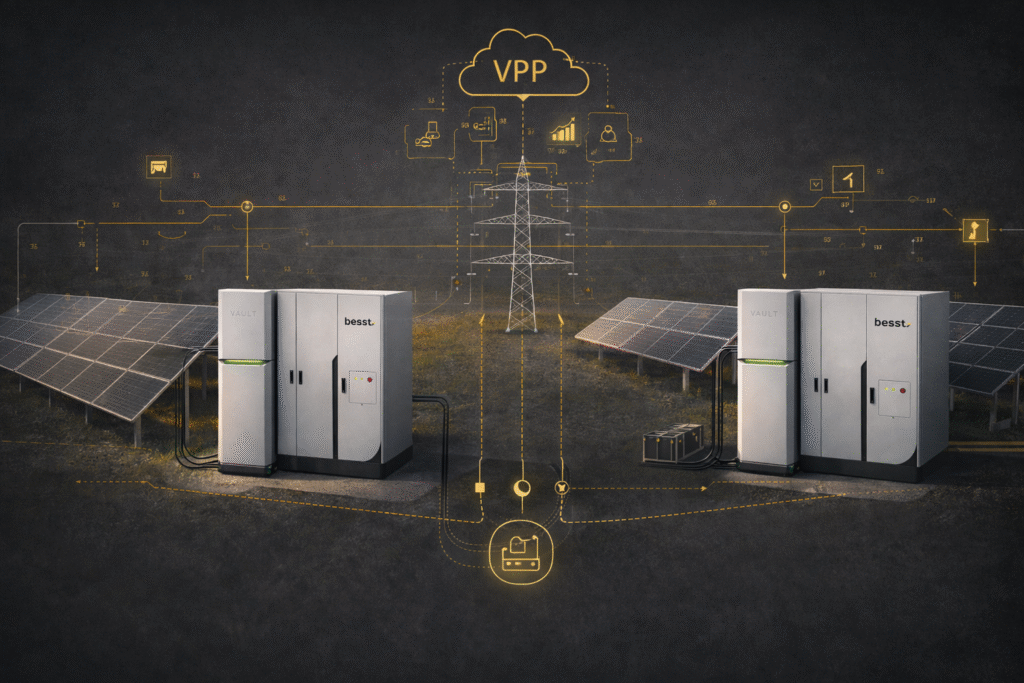
High-end, investment-style infographic illustrating a Virtual Power Plant (VPP) boosting solar profitability. Two separate solar sites sit on the left and right, each shown with ground-mounted solar panels connected by visible black cable routing to the same VAULT battery unit and a besst cabinet. In the center, a transmission tower represents the grid. Above it, a cloud labeled “VPP” connects to both sites with yellow network lines and control icons, showing coordinated dispatch and aggregation. Yellow and black accents dominate on a dark, textured background, with clean technical linework and realistic equipment renders.

Why VPP makes solar more profitable

A Virtual Power Plant is a digitally coordinated network that aggregates many small, distributed energy devices and operates them as a single large asset. These devices typically include home batteries, rooftop solar systems. Centralised software coordinates their operation, allowing the aggregated system to respond to grid needs in real time. Why one battery has limited

Why VPP makes solar more profitable Read More »

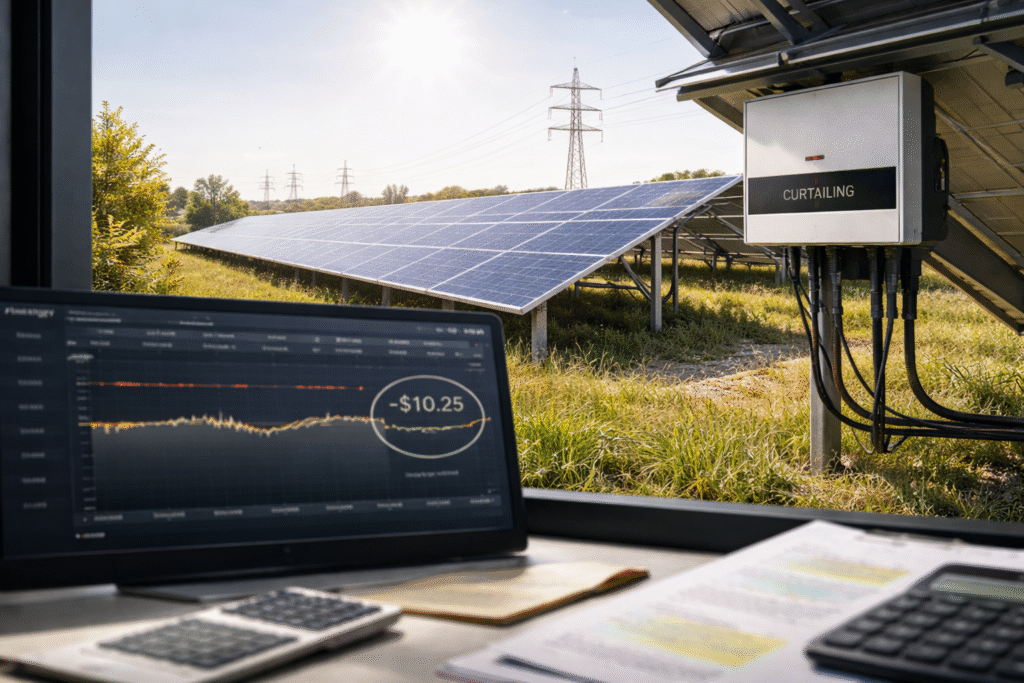
High-end editorial photograph of a ground-mounted solar farm under clear midday light, viewed from inside a control space. In the foreground, a laptop displays an electricity price graph dipping into negative territory, with a highlighted negative price value. Through the window, rows of solar panels operate at full output, while a nearby inverter unit with a red indicator light signals curtailment. Transmission towers stand in the distance, suggesting grid congestion. No energy storage system is present, visually reinforcing the financial losses solar owners face without ESS.

The hidden financial losses every solar owner without ESS faces today

Most households assume solar always saves money. In reality, solar without storage creates several hidden losses that grow larger each year. Net-billing reduces export value. Midday prices collapse during solar peaks. Grid curtailment limits usable generation. A battery offsets these losses by keeping energy inside the home, stabilising consumption, and protecting long-term returns. Why net-billing

The hidden financial losses every solar owner without ESS faces today Read More »

Solar Panels Produce Solar at Noon. You Use Energy at Night. Storage Fixes the Gap.

Solar Panels Produce Solar at Noon. You Use Energy at Night. Storage Fixes the Gap.

Solar panels work on their own schedule. They generate most of their electricity in the middle of the day. Households, however, consume most of their electricity in the evening. This mismatch is responsible for the loss of value in most solar installations. A battery eliminates this gap by storing daytime surplus and delivering it when

Solar Panels Produce Solar at Noon. You Use Energy at Night. Storage Fixes the Gap. Read More »

Monthly Revenue Stream

How to Turn Solar Panels From a Cost Saver Into a Monthly Revenue Stream

Solar panels are effective at reducing electricity bills. On their own, however, they rarely generate income. That changes when solar is combined with a home battery and participation in a Virtual Power Plant (VPP). Together, these elements turn a household from a passive consumer into an active market participant. Instead of only saving money, the

How to Turn Solar Panels From a Cost Saver Into a Monthly Revenue Stream Read More »

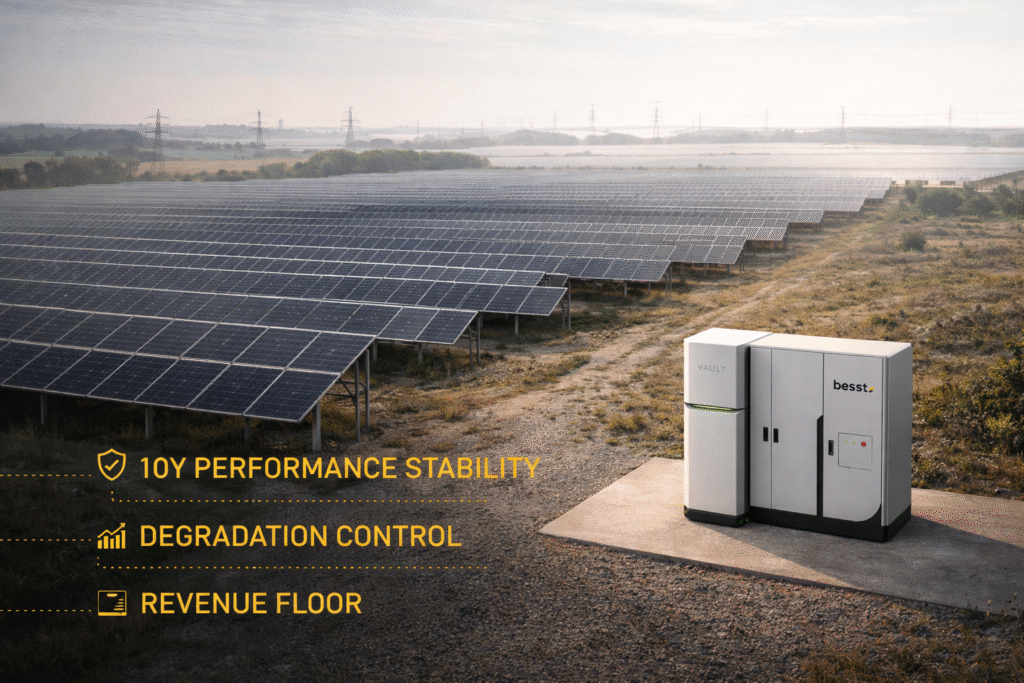
Aerial, high-end editorial photograph of a large utility-scale solar farm stretching to the horizon under soft daylight. In the foreground, a VAULT battery unit stands next to a besst energy storage cabinet on a concrete pad, positioned as central infrastructure supporting the entire site. Subtle yellow graphic overlays highlight “10Y Performance Stability,” “Degradation Control,” and “Revenue Floor,” reinforcing long-term asset protection. Transmission towers are visible in the distance, grounding the scene in grid-connected infrastructure and institutional investment context.Aerial, high-end editorial photograph of a large utility-scale solar farm stretching to the horizon under soft daylight. In the foreground, a VAULT battery unit stands next to a besst energy storage cabinet on a concrete pad, positioned as central infrastructure supporting the entire site. Subtle yellow graphic overlays highlight “10Y Performance Stability,” “Degradation Control,” and “Revenue Floor,” reinforcing long-term asset protection. Transmission towers are visible in the distance, grounding the scene in grid-connected infrastructure and institutional investment context.

How to Protect Your Solar Investment for the Next 10 Years

Solar is a long-term asset. Panels last 20–30 years, but the rules that determine how you are paid for surplus energy can change several times over that period. Today, the biggest risk for solar owners is not technical failure. It is regulatory and market change. Across Europe, net-metering is being phased out. Export tariffs are

How to Protect Your Solar Investment for the Next 10 Years Read More »

How Solar Panel Owners Can Earn From Ancillary Markets

How Solar Panel Owners Can Earn From Ancillary Markets

Most solar owners know how to save money. Few know how to earn it. Ancillary service markets, such as frequency regulation and balancing, were once accessible only to large power plants. Today, aggregated home batteries can participate as well. Even small systems can earn when connected through a Virtual Power Plant (VPP). The household does

How Solar Panel Owners Can Earn From Ancillary Markets Read More »

Scroll to Top